
A Madgicx alternative for teams that need to fix the launch workflow
Madgicx helps optimise Meta campaigns after they are live. Kitchn is built for the operational work that happens before that: preparing, reviewing and launching hundreds or thousands of ads across accounts and channels without creating every ad one by one.
Preparing, reviewing and launching ads at volume across accounts and channels.
Optimising, automating and reporting on Meta campaigns that are already live.
If live Meta optimisation is your bottleneck, Madgicx is probably the better fit.
If building and launching ads at scale is where your team loses its time, that is where Kitchn fits.
Kitchn vs Madgicx: the short answer
| If you need to… | Better fit | Why |
|---|---|---|
| Build and launch large batches of ads | Kitchn | Spreadsheet-like Launch Sheet built around high-volume execution |
| Launch across multiple paid social channels | Kitchn | Eight supported launch channels, including five generally available |
| Catch copy and setup problems before launch | Kitchn | Validation runs before an ad is created |
| Review launches with teams or clients | Kitchn | Row-level statuses, comments and shareable previews |
| Apply repeatable launch standards | Kitchn | Sheet defaults, Ad Templates and naming templates |
| Optimise live Meta campaigns with AI recommendations | Madgicx | This is a core part of AI Marketer |
| Discover and launch AI-driven Meta audiences | Madgicx | Audience Launcher is built specifically for targeting workflows |
| Run advanced live Meta optimisation automation | Madgicx | Madgicx is fundamentally an optimisation product |
| Export client reports as PDFs | Madgicx | One-Click Report supports PDF export |
| Solve both launch operations and live optimisation | Both | They can sit at different stages of the same workflow |
The real question isn't simply “Which tool has more features?”
It's where your paid social operation is getting stuck.
Madgicx optimises the ads. Kitchn gets the ads live.
This is the biggest difference between the two products.
Madgicx
Madgicx is primarily built around Meta advertising optimisation.
Its AI Marketer audits Meta ad accounts and recommends actions. Its automation tools monitor performance and take action around live campaigns. Audience Launcher helps teams build and deploy targeting strategies.
It also has an Ad Launcher for creating and combining Meta ads.
Kitchn
Kitchn starts earlier in the workflow.
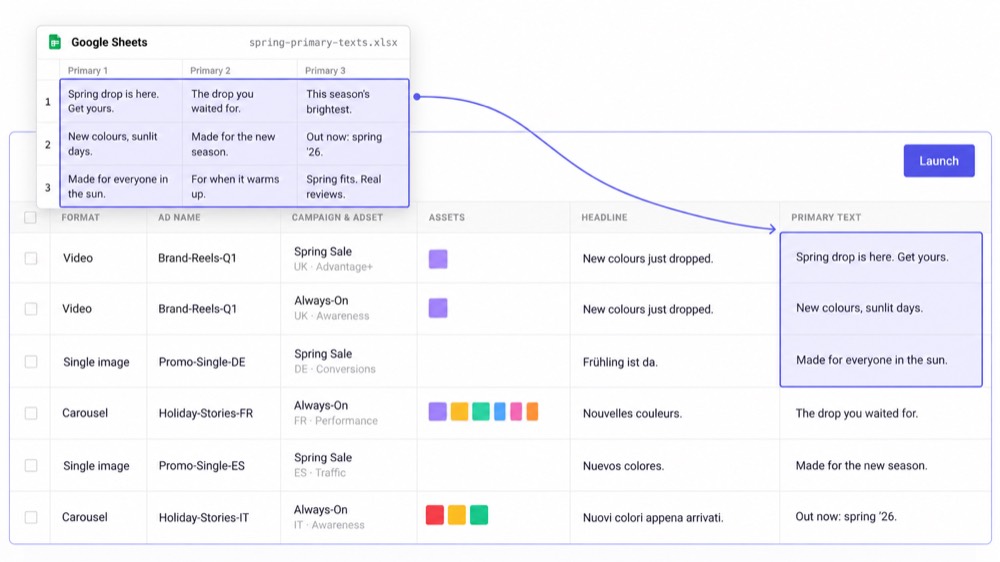
The Launch Sheet is where paid social teams prepare large batches of ads before they go live. One row is one ad. Creative, copy, destination, campaign and ad-set information sit in columns.
Teams can import assets in bulk, edit across selections, review the rows and launch the batch.
If your media buyers spend hours every week getting creative into ad accounts, this distinction matters.
Kitchn.io vs Madgicx feature comparison
| Capability | Kitchn.io | Madgicx |
|---|---|---|
| Primary job | High-volume ad launch operations | Meta optimisation and automation |
| Bulk ad creation | ✓Launch Sheet built around batches of ads | ✓Ad Launcher creates and combines Meta ads |
| Launch into existing Meta ad sets | ✓Supported | ✓Supported |
| New ad-set workflow | Can duplicate an existing ad-set structure on supported channels | Separate Audience Launcher workflow |
| Multi-channel ad launching | ✓8 launch channels, 3 currently beta | Primarily Meta ad launching |
| Pre-launch validation | ✓Runs before the ad is created | ✕No equivalent workflow documented |
| Approval statuses | ✓Configurable row statuses | ✕No equivalent launch-review workflow documented |
| Comments on launch rows | ✓Per row | ✕No equivalent launch-row workflow documented |
| Shareable ad previews | ✓Read-only links | ✕Not documented as part of Ad Launcher |
| Approval blocks launch | ✕Status is visible but does not gate Launch | Not documented |
| Naming templates | ✓Applied per sheet and platform | Asset naming and name stamps, not the same launch-template workflow |
| Naming enforced at launch | ✕Not enforced | Not documented |
| Sheet defaults | ✓Set once per sheet | ✕No Launch Sheet equivalent |
| Reusable ad templates | ✓Org-level, per platform | Saved ad clusters available |
| Per-row change history | ✓With before and after | ✕No equivalent per-row launch history documented |
| AI optimisation recommendations | ✕Not offered | ✓Yes |
| AI audience generation and discovery | ✕Not offered | ✓Yes |
| Live automation rules | ✓Meta and TikTok, narrower than Madgicx | ✓A core strength |
| Creative reporting | ✓Meta, TikTok, Google Ads and Pinterest | ✓Broader reporting and dashboard product |
| Public report links | ✓Yes | ✓Yes |
| PDF report export | ✕Not available | ✓Yes |
| White-label report branding | ✕Not available | ✕Not currently available |
| Pricing tied directly to ad spend | ✕Seats and uploads, not spend | Pro Complete pricing varies with monthly ad spend |
Where Kitchn is stronger
High-volume launch operations
The more creative your team produces, the more painful one-at-a-time execution becomes. At hundreds or thousands of ads per month, uploading stops being a small media-buyer task and starts becoming an operating function.
Kitchn is designed around that problem.
- Paste copy from a spreadsheet.
- Import assets in bulk.
- Bulk edit the rows.
- Review the batch.
- Launch, then move onto the next one while the launch continues.
For a team operating at real volume, that workflow is materially different from using an ad creation feature inside an optimisation platform.
Structural QA happens before the ad is created
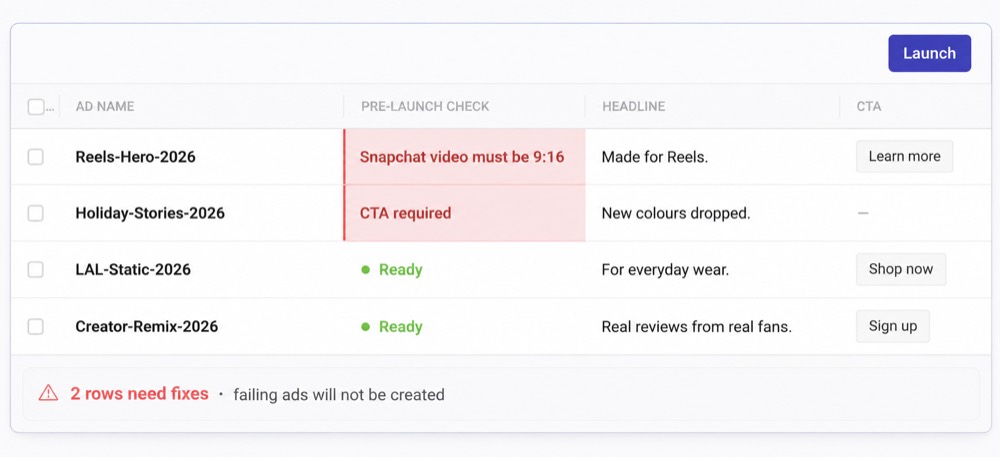
Kitchn runs validation before launch. It checks things such as:
- Required fields
- Schema, length and pattern rules
- URL formatting
- URL-parameter formatting
- Platform-specific specifications
- Meta creative enhancement settings
A row that fails validation enters an error state and the ad is not created.
And it is not only the setup being checked. Kitchn reads the copy too, so a typo or a phrase the client has ruled out gets picked up in the same pass. Whatever it finds, the batch waits until somebody fixes it.
Review the launch without pretending approval is a hard gate
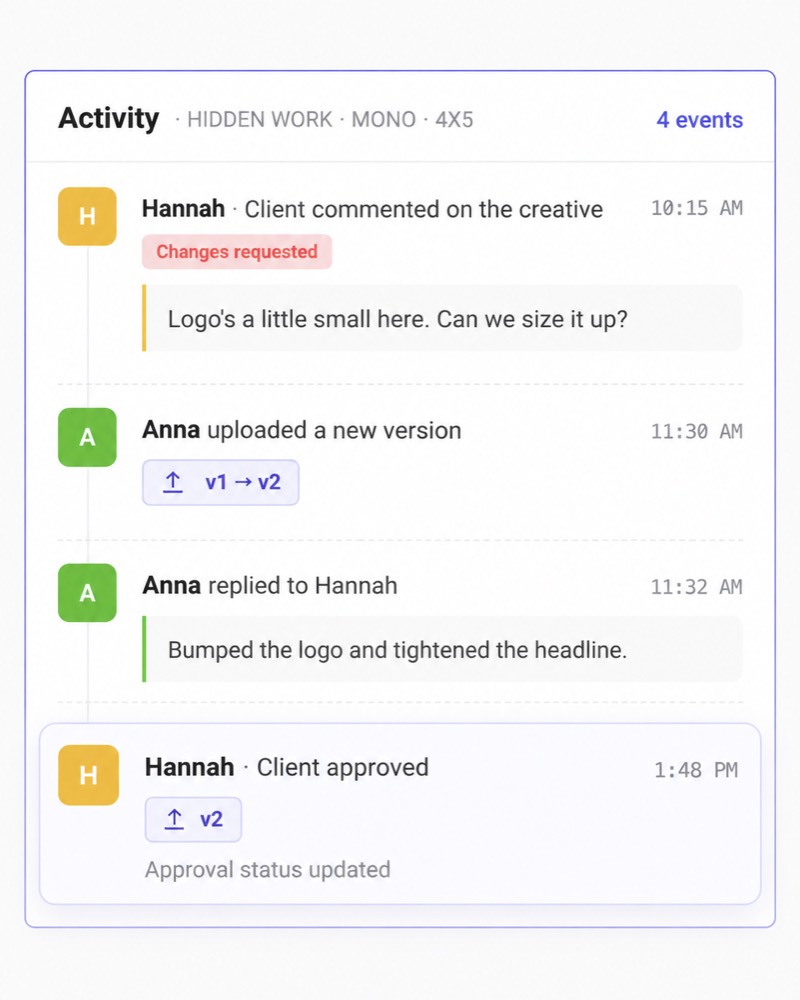
Kitchn gives teams row-level:
- Approval statuses
- Comments
- Ad previews
- Read-only share links
That means a media buyer, team lead, creative team or client can review the actual launch rather than coordinating everything through another spreadsheet and Slack thread.
But approval status does not technically block the Launch button. It gives the team a visible review workflow. The person launching still owns the final action.
For professional paid social teams, that distinction is more useful than pretending software can replace operational responsibility.
Standards without pretending the software polices everything
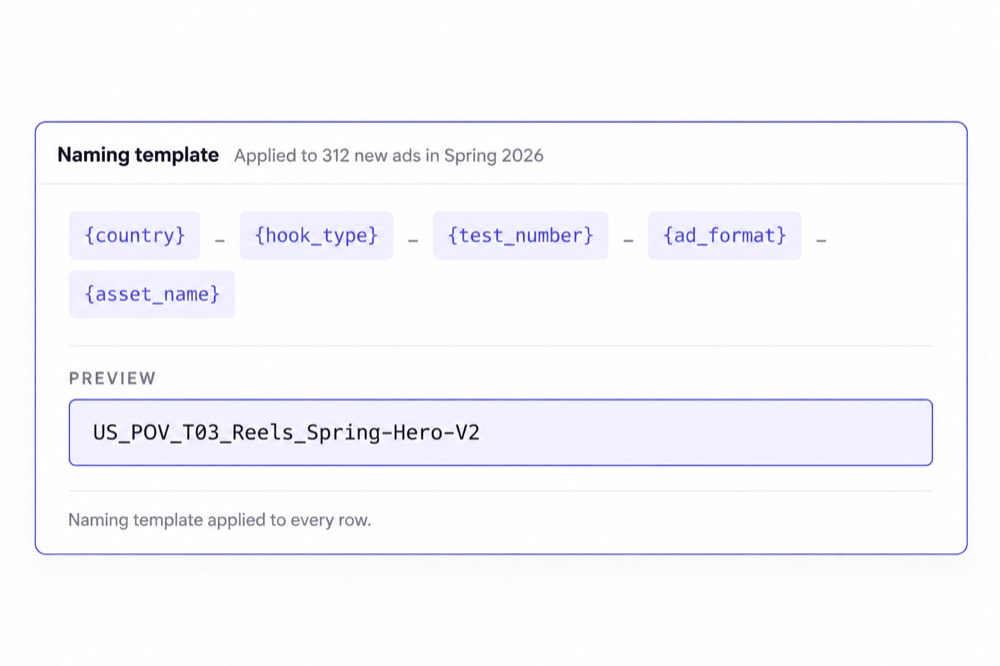
Kitchn can apply naming templates by sheet and platform, alongside reusable Ad Templates and sheet-level defaults. That gives Heads of Paid Social and Operations a more repeatable starting point across accounts.
But naming conventions are applied, not enforced at launch. Kitchn does not reject an ad because somebody manually changed the name.
The practical win is simpler: your media buyers don't have to rebuild the same setup every time, and the operation becomes more consistent as volume grows.
Launch across more than Meta
Kitchn currently supports eight launch channels.
| Meta (Facebook & Instagram) | Generally available |
| TikTok | Generally available |
| Google Ads (Demand Gen) | Generally available |
| Generally available | |
| Snapchat | Generally available |
| Beta | |
| Spotify | Beta |
| AppLovin | Beta |
Google Demand Gen ads are launched into existing ad groups and land paused. Kitchn does not build Google Ads campaigns from scratch.
X can connect to Kitchn, but launching to X is not currently available.
Madgicx's ad-launching workflow is focused on Meta. If your paid social team operates across several channels, that difference becomes more important as the account book grows.
Where Madgicx is stronger
Madgicx is the better product when the problem you are trying to solve is optimisation after launch.
AI-led Meta optimisation
AI Marketer audits Meta accounts and provides recommendations designed around improving live campaign performance.
Kitchn does not have an equivalent autonomous AI media buyer.
Audience discovery and targeting
Madgicx's Audience Launcher is built around finding, creating and deploying Meta audiences.
Kitchn does not generate audiences or recommend targeting strategies.
Live campaign automation
Both products have rules, but they should not be presented as equivalent. Kitchn's Rule Engine handles operational actions on Meta and TikTok, including pausing, renaming and notifications, with some additional actions available on request.
Live Meta optimisation automation is much more central to Madgicx's product.
Reporting beyond creative analysis
Madgicx One-Click Report can combine data from sources including Meta Ads, Google Ads, Google Analytics 4, TikTok, Shopify and Klaviyo. It also supports PDF export.
Kitchn Creative Reporting is more specifically built around analysing the creative itself across Meta, TikTok, Google Ads and Pinterest. Kitchn currently has no PDF export, scheduled email delivery, white-label report branding or currency conversion. If those are requirements, don't pretend otherwise.
Which one is right for your team?
Choose Kitchn if…
- Your team launches hundreds or thousands of ads
- Media buyers spend too much time building and uploading ads
- You operate across multiple paid social channels
- Multiple people touch a launch
- You need structural checks before ads are created
- You want sheet defaults, templates and naming conventions to make launches more repeatable
- Heads of Paid Social need better visibility into how high-volume execution is happening
- Your goal is to increase account or creative capacity without adding manual uploading work at the same rate
Choose Madgicx if…
- Meta is the centre of your paid media operation
- Optimising campaigns after launch is the bigger bottleneck
- You want AI-generated optimisation recommendations
- Audience discovery and targeting automation matter to you
- You want deeper Meta-focused optimisation tooling
- PDF reporting is important to your client reporting process
Use both if…
Your operation has both problems.
Kitchn can handle the structured workflow for getting large volumes of ads live. Madgicx can remain focused on the optimisation work once those Meta ads are running.
They don't need to replace each other simply because they overlap in a few features.
Built for teams where launch volume has become an operational problem
Kitchn makes the most sense when paid social has reached the point where manual execution is limiting capacity. Teams using Kitchn are already operating at that kind of volume.



The common problem isn't a lack of optimisation software. It's that more creative, more accounts and more testing create more operational work.
Kitchn is built to stop that work scaling at the same rate.
You probably don't need a “Madgicx replacement”
You need to identify the bottleneck.
If your Meta campaigns are live and your team needs software deciding what to optimise next, stay with Madgicx.
If your best media buyers are still spending hours copying, uploading, checking and rebuilding large batches of ads, look at Kitchn.
And if both are true,
use both for the jobs they are actually good at.
